
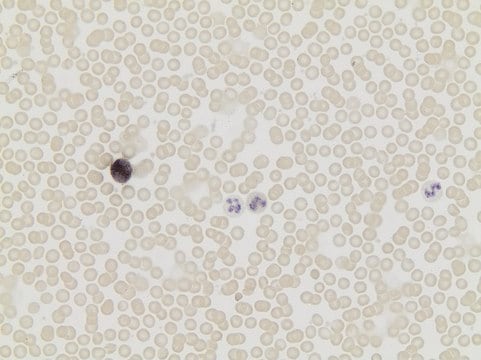


Unfortunately, there is no method to completely prevent this occurrence. Despite using the fluoride inhibition procedure, it is expected that lymphocytes and neutrophils may still exhibit some low levels of staining. Such low levels of staining in these cells are generally considered acceptable and should be disregarded. Hematoxylin staining can aid in distinguishing between the different types of white blood cells, which can be helpful in this context. For laboratories requiring stricter differentiation, it may be advisable to routinely conduct both the non-specific esterase and the non-specific esterase procedure with fluoride inhibition to achieve the desired results.
Fortfahren mit
90A1

Unspezifische Leukozyten-α-Naphthylacetat-Esterase (Kit)
Select reagents packaged in gelatin capsules.
Anmelden zur Ansicht der Organisations- und Vertragspreise.
Größe auswählen
Ansicht ändern
| Packungsgröße | SKU | Verfügbarkeit | Preis |
|---|---|---|---|
| 1 kit | Warenkorb auf Verfügbarkeit prüfen | € 527,00 |
Über diesen Artikel
Technischer Dienst
Benötigen Sie Hilfe? Unser Team von erfahrenen Wissenschaftlern ist für Sie da.
Unterstützung erhaltenQuality Level
form
liquid
shelf life
Expiry date on the label.
IVD
for in vitro diagnostic use
application(s)
hematology
histology
shipped in
wet ice
storage temp.
2-8°C
Application
Esterasen sind in der Natur ubiquitär vorhanden; zu ihnen gehört eine Reihe unterschiedlicher Enzyme, die jeweils spezifische Substrate umsetzen. Gemäß der Methodik wird α-Naphthylacetat enzymatisch hydrolysiert, wobei eine freie Naphtholverbindung freigesetzt wird. Diese bindet anschließend an eine Diazoniumverbindung, wodurch an Orten nicht-spezifischer Esteraseaktivität schwarze Ablagerungen entstehen. Dieses Enzym wird hauptsächlich in Monozyten, Makrophagen und Histozyten nachgewiesen und ist normalerweise in Granulozyten nicht vorhanden. Lymphozyten können gelegentlich Enzymaktivität an den Tag legen. Ein Verfahren zur Natriumfluorid-Hemmung kann ausgeführt werden, um die Inhibierung von Monozyten zu belegen. Das Verfahren wird bei 37 °C an Blut, Knochenmarkfilmen, Touch-Gewebepräparaten, Zytozentrifugen-Präparaten und Gefrierschnitten durchgeführt. Das Enzym wird durch eine Paraffin-Aufbereitung abgetötet.
Für den zytologischen Nachweis von α-Naphthylacetatesterase im Blut, in Knochenmarkfilmen oder Touch-Gewebepräparaten vorgesehen.
1 of 1
Dieser Artikel | |||
|---|---|---|---|
| form liquid | form liquid | form solution | form solution |
| application(s) hematology | application(s) hematology | application(s) hematology | application(s) hematology |
| shipped in wet ice | shipped in wet ice | shipped in wet ice | shipped in wet ice |
| shelf life Expiry date on the label. | shelf life Expiry date on the label. | shelf life Expiry date on the label. | shelf life Expiry date on the label. |
| Quality Level 500 | Quality Level 500 | Quality Level 500 | Quality Level 500 |
| storage temp. 2-8°C | storage temp. 2-8°C | storage temp. 2-8°C | storage temp. 2-8°C |
Still not finding the right product?
Explore all of our products under Unspezifische Leukozyten-α-Naphthylacetat-Esterase (Kit)
Nur Kit-Komponenten
Produkt-Nr.
Beschreibung
- α-Naphthyl acetate (90-6) 10 x 20
- Citrate solution (386-1) 20 mL
- Ethylene glycol monomethyl ether 25 mL
- Fast Blue RR Salt (FBS-25) 10 caps
- Mayer's Hematoxylin Solution (MHS-1) 100 mL
- TRIZMAL™ 7.6 Concentrate 50 mL
signalword
Danger
Lagerklasse
3 - Flammable liquids
flash_point_f
104.0 °F - closed cup
flash_point_c
40 °C - closed cup
Hazard Classifications
Acute Tox. 4 Dermal - Acute Tox. 4 Inhalation - Acute Tox. 4 Oral - Aquatic Acute 1 - Aquatic Chronic 1 - Eye Dam. 1 - Flam. Liq. 3 - Met. Corr. 1 - Repr. 1B - Skin Corr. 1B - STOT RE 2 - STOT RE 2 Oral - STOT SE 1
target_organs
Central nervous system, Immune system, thymus
Hier finden Sie alle aktuellen Versionen:
Besitzen Sie dieses Produkt bereits?
In der Dokumentenbibliothek finden Sie die Dokumentation zu den Produkten, die Sie kürzlich erworben haben.
Global Trade Item Number
| SKU | GTIN |
|---|---|
| 90A1-1KT | 04061833253540 |
-
How can the procedure be optimized to prevent any staining of non-specific esterase within lymphocytes or neutrophils
1 answer-
Helpful?
-