



If this product has an expiration or retest date, it will be shown on the Certificate of Analysis (COA, CofA). If there is no retest or expiration date listed on the product's COA, we do not have suitable stability data to determine a shelf life. For these products, the only date on the COA will be the release date; a retest, expiration, or use-by-date will not be displayed.
For all products, we recommend handling per defined conditions as printed in our product literature and website product descriptions. We recommend that products should be routinely inspected by customers to ensure they perform as expected.
For products without retest or expiration dates, our standard warranty of 1 year from the date of shipment is applicable.
For more information, please refer to the Product Dating Information document: https://www.sigmaaldrich.com/deepweb/assets/sigmaaldrich/marketing/global/documents/418/501/product-dating-information-06-25-mk.pdf
Fortfahren mit
E7750

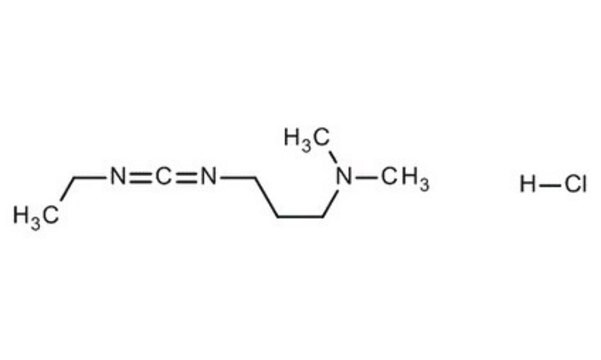
N-(3-Dimethylaminopropyl)-N′-ethylcarbodiimid -hydrochlorid
commercial grade, powder
Synonym(e):
N-Ethyl-N′-(3-dimethylaminopropyl)-carbodiimid -hydrochlorid, EDAC, EDC, WSC -hydrochlorid
Größe auswählen
| Packungsgröße | SKU | Verfügbarkeit | Preis |
|---|
Über diesen Artikel
Quality Level
form
powder
technique(s)
Northern blotting: suitable, bioconjugation: suitable
color
white to off-white
mp
110-115 °C (lit.)
solubility
H2O: ≤100 mg/mL
storage temp.
−20°C
SMILES string
Cl.CCN=C=NCCCN(C)C
InChI
1S/C8H17N3.ClH/c1-4-9-8-10-6-5-7-11(2)3;/h4-7H2,1-3H3;1H
InChI key
FPQQSJJWHUJYPU-UHFFFAOYSA-N
General description
Die Vielseitigkeit von EDC-HCl zeigt sich weiter in der Fähigkeit zur Modifizierung von Nukleinsäuren, die die Markierung von DNA und RNA über ihre 5′-Phosphatgruppen ermöglicht. Diese Funktion verbessert die Visualisierung, Nachverfolgung und Analyse dieser wichtigen Moleküle und trägt signifikant zum Fortschritt in der Nukleinsäureforschung bei. Darüber hinaus dient EDC-HCl als Brücke für wichtige Biomoleküle, indem es als Crosslinker fungiert, der aminreaktive NHS-Ester aus Biomolekülen mit Carboxylgruppen verbindet. Diese Technik erweist sich als besonders wertvoll bei der Proteinkonjugation und ermöglicht die Erzeugung von Hybridmolekülen mit neuartigen Eigenschaften und Funktionen. Der zugrunde liegende Mechanismus von EDC-HCl umfasst die Reaktion mit einer Carboxylgruppe, die ein instabiles Zwischenprodukt bildet, das aktiv einen Aminpartner sucht. Das empfindliche Gleichgewicht dieser Reaktion unterstreicht die Notwendigkeit der Optimierung von Bedingungen, um eine effiziente Konjugation zu gewährleisten. Durch die Unterstützung von N-Hydroxysuccinimid (NHS) werden die Fähigkeiten von EDC-HCl weiter verbessert, das Zwischenprodukt stabilisiert und Konjugationsverfahren in zwei Schritten ermöglicht. Dies bietet mehr Flexibilität und Kontrolle, insbesondere bei komplexen Biomolekülen.
Application
- N-(3-Dimethylaminopropyl)-N′-ethylcarbodiimid-hydrochlorid wurde für die Herstellung von Biokonjugaten aus fluoreszierenden Nanodiamanten (FND) und Transferrin verwendet.
- Es wurde für die Vernetzung von Polyethylenimin mit Goldpartikeln eingesetzt.[1]
- Es wurde als Carbodiimid-Verbindungsmittel für die Beschichtung von carboxylierten Polystyrolkügelchen mit biotinyliertem BSA (Rinderserumalbumin) eingesetzt.
Biochem/physiol Actions
Features and Benefits
Other Notes
1 of 1
Dieser Artikel | |||
|---|---|---|---|
| form powder | form crystalline | form powder | form solid |
| technique(s) Northern blotting: suitable, bioconjugation: suitable | technique(s) - | technique(s) bioconjugation: suitable | technique(s) - |
| storage temp. −20°C | storage temp. −20°C | storage temp. −20°C | storage temp. −20°C (−15°C to −25°C) |
| Quality Level 300 | Quality Level 200 | Quality Level 200 | Quality Level 200 |
| solubility H2O: ≤100 mg/mL | solubility H2O: ≤100 mg/mL | solubility H2O: soluble 0.2 g/L | solubility - |
| color white to off-white | color white to off-white | color - | color - |
Still not finding the right product?
Explore all of our products under N-(3-Dimethylaminopropyl)-N′-ethylcarbodiimid -hydrochlorid
signalword
Danger
target_organs
Stomach,large intestine,lymph node
Lagerklasse
6.1C - Combustible acute toxic Cat.3 / toxic compounds or compounds which causing chronic effects
flash_point_f
Not applicable
flash_point_c
Not applicable
ppe
dust mask type N95 (US), Eyeshields, Gloves
Hazard Classifications
Acute Tox. 3 Dermal - Acute Tox. 4 Oral - Aquatic Acute 1 - Aquatic Chronic 1 - Eye Irrit. 2 - Skin Irrit. 2 - Skin Sens. 1 - STOT RE 2 Oral
Hier finden Sie alle aktuellen Versionen:
Besitzen Sie dieses Produkt bereits?
In der Dokumentenbibliothek finden Sie die Dokumentation zu den Produkten, die Sie kürzlich erworben haben.
Artikel
Click chemistry, and the copper(I)-catalyzed azide-alkyne cycloaddition (CuAAC) in particular, is a powerful new synthetic tool in polymer chemistry and material science.
Verwandter Inhalt
Find high-purity biochemicals for every workflow. Explore BioUltra, Molecular Biology, BioReagent, and reagent-grade materials qualified for performance.
Discover how Estapor® Red Intense microspheres outperform colloidal gold in lateral flow immunoassays, enhancing sensitivity, speed, and reliability for diagnostic applications.
Global Trade Item Number
| SKU | GTIN |
|---|---|
| E7750-10G | 04061835516018 |
| E7750-5G | 04061835538379 |
| E7750-1KG | 04061835544653 |
| E7750-5KG | 04061832862132 |
| E7750-100MG | 04061835544646 |
| E7750-1G | 04061835483433 |
| E7750-25G | 04061835544660 |
| E7750-100G | 04061835544639 |
-
How can I determine the shelf life / expiration / retest date of this product?
1 answer-
Helpful?
-
-
How is shipping temperature determined? And how is it related to the product storage temperature?
1 answer-
Products may be shipped at a different temperature than the recommended long-term storage temperature. If the product quality is sensitive to short-term exposure to conditions other than the recommended long-term storage, it will be shipped on wet or dry-ice. If the product quality is NOT affected by short-term exposure to conditions other than the recommended long-term storage, it will be shipped at ambient temperature. As shipping routes are configured for minimum transit times, shipping at ambient temperature helps control shipping costs for our customers. For more information, please refer to the Storage and Transport Conditions document: https://www.sigmaaldrich.com/deepweb/assets/sigmaaldrich/marketing/global/documents/316/622/storage-transport-conditions-mk.pdf
Helpful?
-
-
What impurities might be present in N-(3-Dimethylaminopropyl)-N´-ethylcarbodiimide hydrochloride, Product E7750?
1 answer-
The two compounds most likely to appear in EDAC as trace impurities are 3-dimethylaminopropylamine and N-(3-dimethylaminopropyl)-N'-ethylurea as a result of synthesis (intermediate) and degradation (moisture or coupling reaction), respectively.
Helpful?
-
-
Product No. E7750, N-(3-Dimethylaminopropyl)-N´-ethylcarbodiimide hydrochloride, is listed as "commercial grade". What does that mean?
1 answer-
It means that it is the grade of N-(3-Dimethylaminopropyl)-N´-ethylcarbodiimide (EDAC) hydrochloride that was commercially available at the time we purchased it. This product is not assayed for purity. If you need a high purity EDAC, consider Product No. 03450.
Helpful?
-
-
What is the Department of Transportation shipping information for this product?
1 answer-
Transportation information can be found in Section 14 of the product's (M)SDS.To access the shipping information for this material, use the link on the product detail page for the product.
Helpful?
-
-
Can N-(3-Dimethylaminopropyl)-N´-ethylcarbodiimide hydrochloride, Product E7750, be used as a peptide coupling reagent in alcoholic solvents? If so, do you have a reference?
1 answer-
Yes. Nosaki, S., Effects of amounts of additives on peptide coupling mediated by a water-soluble carbodiimide in alcohols. J. Peptide Res., 54(2), 162-167 (1999). This paper describes using the E7750 along with 3,4-dihydro-3-hydroxy-4-oxo-1,2,3-benzotriazine (HOOBt) and 1-hydroxy-7-azabenzotriazole (HOAt) for enhancement of peptide coupling.
Helpful?
-
-
I understand that E7750, N-(3-Dimethylaminopropyl)-N´-ethylcarbodiimide hydrochloride, can be used in peptide synthesis. Do you have a brochure on some other reagents that can be used for peptide synthesis?
1 answer-
Yes.
Helpful?
-