
MAB4419

Anti-OCT-4-[POU5F1-]Antikörper, Klon 7F9.2
clone 7F9.2, from mouse
Synonym(e):
Octamer-binding transcription factor 3, POU class 5 homeobox 1, POU domain class 5, transcription factor 1, POU-type homeodomain-containing DNA-binding protein, octamer-binding transcription factor-3
Größe auswählen
| Packungsgröße | SKU | Verfügbarkeit | Preis |
|---|---|---|---|
| 100 μg | Warenkorb auf Verfügbarkeit prüfen | € 506,00 |
Über diesen Artikel
biological source
mouse
Quality Level
conjugate
unconjugated
antibody form
purified immunoglobulin
antibody product type
primary antibodies
clone
7F9.2, monoclonal
species reactivity
human, mouse
technique(s)
flow cytometry: suitable, immunocytochemistry: suitable, western blot: suitable
input
sample type: human embryonic stem cell(s)
sample type induced pluripotent stem cell(s)
sample type: mouse embryonic stem cell(s)
isotype
IgG1κ
NCBI accession no.
UniProt accession no.
shipped in
wet ice
target post-translational modification
unmodified
Gene Information
human ... POU5F1(5460)
mouse ... Pou5F1(18999)
General description
Immunogen
Application
Stammzellenforschung
Pluripotente & frühe Differenzierung
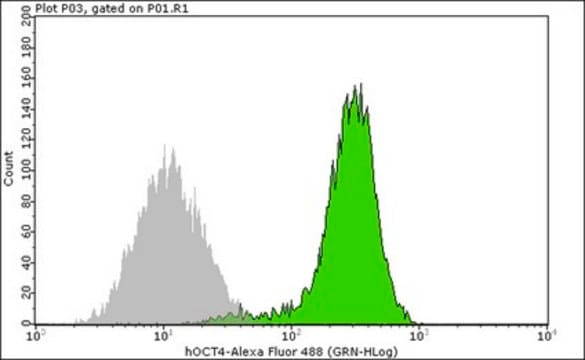
Durchflusszytometrie: Die empfohlene Arbeitsverdünnung beträgt 2 µg/ml.
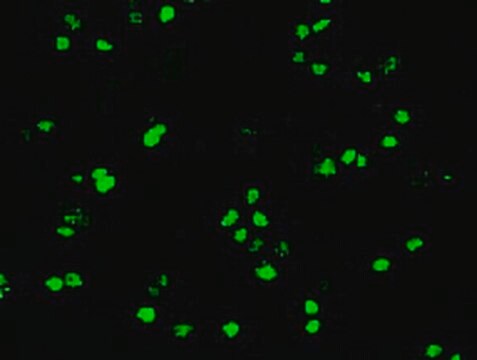
Immunzytochemie: Die empfohlene Arbeitsverdünnung beträgt 1:100–1: 200.
Biochem/physiol Actions
Physical form
Preparation Note
Other Notes
Disclaimer
1 of 1
Dieser Artikel | |||
|---|---|---|---|
| Gene Information human ... POU5F1(5460) | Gene Information human ... POU5F1(5460) | Gene Information human ... POU5F1(5460) | Gene Information human ... POU5F1(5460) |
| antibody form purified immunoglobulin | antibody form purified immunoglobulin | antibody form purified immunoglobulin | antibody form purified antibody |
| species reactivity human, mouse | species reactivity human | species reactivity mouse | species reactivity human |
| biological source mouse | biological source mouse | biological source mouse | biological source mouse |
| clone 7F9.2, monoclonal | clone PF-29, monoclonal | clone 9B7, monoclonal | clone 10H11.2, monoclonal |
| conjugate unconjugated | conjugate unconjugated | conjugate unconjugated | conjugate ALEXA FLUOR™ 488 |
![Anti-OCT-4 [POU5F1] Antibody, clone 7F9.2 clone 7F9.2, from mouse](/deepweb/assets/sigmaaldrich/product/images/307/874/7354f72d-80ee-40a5-b7fa-0590fe6784cc/640/7354f72d-80ee-40a5-b7fa-0590fe6784cc.jpg)

Still not finding the right product?
Probieren Sie unser Produkt-Auswahlhilfe, um Ihre Auswahl einzugrenzen
Lagerklasse
12 - Non Combustible Liquids
wgk
WGK 1
flash_point_f
Not applicable
flash_point_c
Not applicable
Analysenzertifikate (COA)
Suchen Sie nach Analysenzertifikate (COA), indem Sie die Lot-/Chargennummer des Produkts eingeben. Lot- und Chargennummern sind auf dem Produktetikett hinter den Wörtern ‘Lot’ oder ‘Batch’ (Lot oder Charge) zu finden.
Besitzen Sie dieses Produkt bereits?
In der Dokumentenbibliothek finden Sie die Dokumentation zu den Produkten, die Sie kürzlich erworben haben.
Artikel
Skip weekend feedings. Defined serum-free and feeder-free expansion media for human pluripotent stem cells (ES and iPS cells). See publications and protocols.
The Simplicon™ RNA Reprogramming Technology is a next generation reprogramming system that uses a single synthetic, polycistronic self-replicating RNA strand engineered to mimic cellular RNA to generate human iPS cells.
Verwandter Inhalt
Human iPSC neural differentiation media and protocols used to generate neural stem cells, neurons and glial cell types.
As the focus of stem cell research undergoes a transition from animal to human models, researchers are in critical need of validated products to support the isolation, maintenance, differentiation, and characterization of human stem cells. While many reagents designed for rodent systems can be applied to human stem cell studies, they are not truly optimized for robust human stem cell culture or analysis. This is why human stem cell researchers have always trusted EMD Millipore, the first provider of commercially available human embryonic stem cells and human neural stem cell lines, to accelerate their research. All of our human stem cell systems are extensively tested in defined media culture, and differentiated progeny are comprehensively characterized with highly validated antibodies and detection reagents.
Global Trade Item Number
| SKU | GTIN |
|---|---|
| MAB4419 | 04053252503436 |