Direkt zum Inhalt
Merck

Fortfahren mit

ABS2215

Anti-Uromodulin/THP

Synonym(e):

Tamm-Horsfall urinary glycoprotein;THP

Anmelden zur Ansicht der Organisations- und Vertragspreise.

Größe auswählen

Ansicht ändern
Ihnen/SKUVerfügbarkeitPreis

Über diesen Artikel

NACRES:
NA.43
UNSPSC Code:
12352203
Conjugate:
unconjugated
Clone:
polyclonal
Application:
IHC, WB
Citations:
-
Preise und Verfügbarkeit sind derzeit nicht verfügbar.
Technischer Dienst
Benötigen Sie Hilfe? Unser Team von erfahrenen Wissenschaftlern ist für Sie da.
Unterstützung erhalten


biological source

rabbit

Quality Segment

conjugate

unconjugated

antibody form

purified antibody

antibody product type

primary antibodies

clone

polyclonal

mol wt

calculated mol wt 69.76 kDa, observed mol wt ~105 kDa

purified by

affinity chromatography

species reactivity

human

packaging

antibody small pack of 100 μg

technique(s)

immunohistochemistry: suitable, western blot: suitable

isotype

IgGκ

epitope sequence

C-terminal

Protein ID accession no.

UniProt accession no.

storage temp.

2-8°C

target post-translational modification

unmodified

Gene Information

human ... UMOD(7369)

General description

Uromodulin (UniProt: P07911; also known as Tamm-Horsfall urinary glycoprotein, THP) is encoded by the UMOD gene (Gene ID: 7369) in human. Uromodulin is a homodimeric glycoprotein that is produced in the kidney and can polymerize into long filaments. It is expressed in the tubular cells of the kidney and is most abundant protein in normal urine. It plays a role in biogenesis and organization of the apical membrane of epithelial cells of the thick ascending limb of Henle′s loop, where it promotes formation of complex filamentous gel-like structure that may play a role in the water barrier permeability. It also facilitates neutrophil migration across renal epithelia. Uromodulin contains a ZP domain (aa 334-589) that mediates polymerization, leading to the formation of long filaments. The core of the filament consists of stacked ZP domains, which assemble into a helical structure. Each ZP domain consists of an N-terminal (ZP-N; aa 334-429) and C-terminal (ZP-C; aa 465-589) region connected by a flexible linker. The linker allows the ZP domain to wrap around the ZP-C subdomain of the preceding subunit. It is proteolytically cleaved at a conserved C-terminal proteolytic cleavage site to generate the secreted form found in the urine. In the urine, it may contribute to colloid osmotic pressure, retard passage of positively charged electrolytes, and prevent urinary tract infection. It also inhibits the formation of liquid containing supersaturated salts and subsequent formation of salt crystals. Five isoforms of uromodulin have been described that are produced by alternative splicing. (Ref.: Micanovic, R., et al. (2022). Am. J. Physiol. Renal Physiol. 322(4); F403-418; Schmid, M., et al. (2010). Cell Physiol. Biochem. 26(3); 311-318; Santambrogio, S., et al. (2008). Biochem. Biophys. Res. Commun. 370(3); 410-413).

Immunogen

KLH-conjugated linear peptide corresponding to 22 amino acids from the C-terminal region of Human Uromodulin/THP.

Application

Quality Control Testing

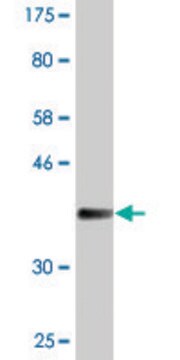
Evaluated by Western Blotting in Human kidney tissue lysate.

Western Blotting Analysis: A 1:1,000 dilution of this antibody detected Uromodulin/THP in Human kidney tissue lysate.

Tested applications

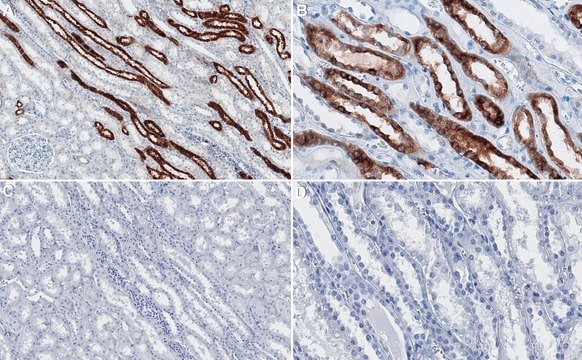
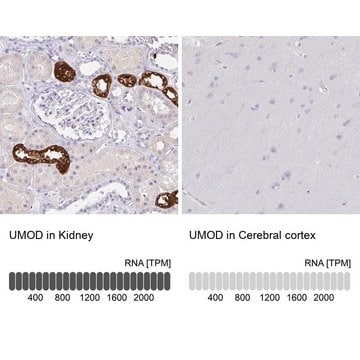
Immunohistochemistry (Paraffin) Analysis: A 1:1,000 dilution from a representative lot detected Uromodulin/THP in human kidney tissue sections.

Note: Actual optimal working dilutions must be determined by end user as specimens, and experimental conditions may vary with the end user

Biochem/physiol Actions

This rabbit polyclonal antibody detects Uromodulin/THP. It targets an epitope within 22 amino acids from the C-terminal region.

Physical form

Purified rabbit polyclonal antibody in PBS with 0.02% sodium azide.

Preparation Note

1.0 mg/mL. Please refer to guidance on suggested starting dilutions and/or titers per application and sample type.
Recommended storage: +2°C to +8°C.

Other Notes

Concentration: Please refer to the Certificate of Analysis for the lot-specific concentration.

Disclaimer

Unless otherwise stated in our catalog or other company documentation accompanying the product(s), our products are intended for research use only and are not to be used for any other purpose, which includes but is not limited to, unauthorized commercial uses, in vitro diagnostic uses, ex vivo or in vivo therapeutic uses or any type of consumption or application to humans or animals.

Ähnliche Artikel vergleichen

Vollständigen Vergleich anzeigen

Unterschiede anzeigen

1 of 1

Dieser Artikel
SAB1401395SAB1400296HPA043420
conjugate

unconjugated

conjugate

unconjugated

conjugate

unconjugated

conjugate

unconjugated

antibody form

purified antibody

antibody form

purified immunoglobulin

antibody form

IgG fraction of antiserum

antibody form

affinity isolated antibody

species reactivity

human

species reactivity

human

species reactivity

human

species reactivity

human

clone

polyclonal

clone

3F10, monoclonal

clone

polyclonal

clone

polyclonal

biological source

rabbit

biological source

mouse

biological source

mouse

biological source

rabbit

technique(s)

immunohistochemistry: suitable, western blot: suitable

technique(s)

capture ELISA: suitable, immunoprecipitation (IP): suitable, western blot: 1-5 μg/mL

technique(s)

immunohistochemistry (formalin-fixed, paraffin-embedded sections): suitable, indirect immunofluorescence: suitable, western blot: 1 μg/mL

technique(s)

immunohistochemistry: 1:1000-1:2500


Still not finding the right product?

Probieren Sie unser Produkt-Auswahlhilfe, um Ihre Auswahl einzugrenzen


Lagerklasse

12 - Non Combustible Liquids

wgk

WGK 2

flash_point_f

Not applicable

flash_point_c

Not applicable


Analysenzertifikate (COA)

Suchen Sie nach Analysenzertifikate (COA), indem Sie die Lot-/Chargennummer des Produkts eingeben. Lot- und Chargennummern sind auf dem Produktetikett hinter den Wörtern ‘Lot’ oder ‘Batch’ (Lot oder Charge) zu finden.

Besitzen Sie dieses Produkt bereits?

In der Dokumentenbibliothek finden Sie die Dokumentation zu den Produkten, die Sie kürzlich erworben haben.

Die Dokumentenbibliothek aufrufen


Questions

Reviews

No rating value

Active Filters