Direkt zum Inhalt
Merck

Fortfahren mit

AB15736

Anti-Parvalbumin Antibody

CHEMICON®, rabbit polyclonal

Anmelden zur Ansicht der Organisations- und Vertragspreise.

Größe auswählen

Ansicht ändern
PackungsgrößeSKUVerfügbarkeitPreis
100 μL
Warenkorb auf Verfügbarkeit prüfen
€ 416,00

Über diesen Artikel

UNSPSC Code:
12352203
eCl@ss:
32160702
NACRES:
NA.41
Clone:
polyclonal
Species reactivity:
human
Application:
IHC
Citations:
13

€ 416,00


Warenkorb auf Verfügbarkeit prüfen
Für Ihr Target ist ein rekombinanter, konservierungsmittelfreier Antikörper verfügbar. Probieren Sie ZRB1218

Technischer Dienst
Benötigen Sie Hilfe? Unser Team von erfahrenen Wissenschaftlern ist für Sie da.
Unterstützung erhalten


Produktname

Anti-Parvalbumin Antibody, serum, Chemicon®

biological source

rabbit

Quality Level

antibody form

serum

antibody product type

primary antibodies

clone

polyclonal

species reactivity

human

manufacturer/tradename

Chemicon®

technique(s)

immunohistochemistry: suitable (paraffin)

NCBI accession no.

UniProt accession no.

shipped in

wet ice

target post-translational modification

unmodified

Gene Information

human ... PVALB(5816)

Immunogen

Synthetic peptide.

Application

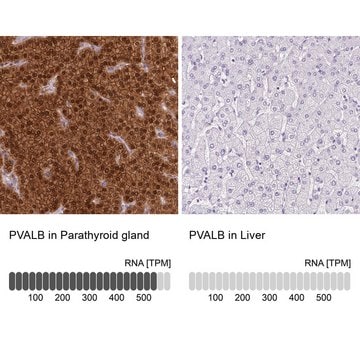
Immunohistochemistry: 1:100 on paraffin embedded, 10% neutral Buffered Formalin fixed human cerebellum tissue. Suggested pretreatment is HIER (Heat Induced Epitope Retrieval) using Citrate buffer, pH 6.0. Detection system was the IHC-Select HRP-DAB system.
Research Category
Neuroscience
Research Sub Category
Signaling Neuroscience
This Anti-Parvalbumin Antibody is validated for use in IH(P) for the detection of Parvalbumin.

Biochem/physiol Actions

Parvalbumin. Immunoreactivity is seen primarily in Purkinje cells. Immunostaining is completely eliminated when the antibody is incubated with the immunogen peptide prior to staining.

Physical form

Liquid.
Serum

Preparation Note

1 year at -20°C from date of shipment

Other Notes

Replaces: AB9312

Legal Information

CHEMICON is a registered trademark of Merck KGaA, Darmstadt, Germany

Disclaimer

Unless otherwise stated in our catalog or other company documentation accompanying the product(s), our products are intended for research use only and are not to be used for any other purpose, which includes but is not limited to, unauthorized commercial uses, in vitro diagnostic uses, ex vivo or in vivo therapeutic uses or any type of consumption or application to humans or animals.

Ähnliche Artikel vergleichen

Vollständigen Vergleich anzeigen

Unterschiede anzeigen

1 of 1

Dieser Artikel
HPA048536SAB2500752MAB1572
antibody form

serum

antibody form

affinity isolated antibody

antibody form

affinity isolated antibody

antibody form

ascites fluid

Quality Level

100

Quality Level

100

Quality Level

100

Quality Level

100

biological source

rabbit

biological source

rabbit

biological source

goat

biological source

mouse

UniProt accession no.

P20472

UniProt accession no.

P20472

UniProt accession no.

P20472

UniProt accession no.

P20472

Gene Information

human ... PVALB(5816)

Gene Information

human ... PVALB(5816)

Gene Information

human ... PVALB(5816)

Gene Information

human ... PVALB(5816)

species reactivity

human

species reactivity

human

species reactivity

human, rat

species reactivity

feline, rabbit, goat, frog, fish, human, pig, bovine, rat, mouse, canine


Still not finding the right product?

Explore all of our products under

oder

Probieren Sie unser Produkt-Auswahlhilfe, um Ihre Auswahl einzugrenzen


Lagerklasse

10 - Combustible liquids

wgk

WGK 1

flash_point_f

Not applicable

flash_point_c

Not applicable


Analysenzertifikate (COA)

Suchen Sie nach Analysenzertifikate (COA), indem Sie die Lot-/Chargennummer des Produkts eingeben. Lot- und Chargennummern sind auf dem Produktetikett hinter den Wörtern ‘Lot’ oder ‘Batch’ (Lot oder Charge) zu finden.

Besitzen Sie dieses Produkt bereits?

In der Dokumentenbibliothek finden Sie die Dokumentation zu den Produkten, die Sie kürzlich erworben haben.

Die Dokumentenbibliothek aufrufen


Daniel E Winkowski et al.
Cerebral cortex (New York, N.Y. : 1991), 28(3), 868-879 (2017-01-11)
Sensory environments change over a wide dynamic range and sensory processing can change rapidly to facilitate stable perception. While rapid changes may occur throughout the sensory processing pathway, cortical changes are believed to profoundly influence perception. Prior stimulation studies showed
Julia Ahlfeld et al.
Scientific reports, 7(1), 6137-6137 (2017-07-25)
We identified a rare undifferentiated cell population that is intermingled with the Bergmann glia of the adult murine cerebellar cortex, expresses the stem cell markers Sox2 and Nestin, and lacks markers of glial or neuronal differentiation. Interestingly, such Sox2+ S100-
Pedro Royero et al.
Cell reports, 41(10), 111757-111757 (2022-12-09)
Maintaining an appropriate balance between excitation and inhibition is critical for neuronal information processing. Cortical neurons can cell-autonomously adjust the inhibition they receive to individual levels of excitatory input, but the underlying mechanisms are unclear. We describe that Ste20-like kinase


Global Trade Item Number

SKUGTIN
AB1573604053252729614

Questions

Reviews

No rating value

Active Filters