
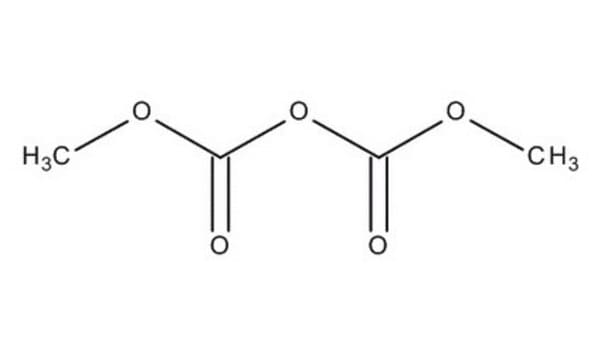




Preparing RNase-free water, Dimethyl dicarbonate (DMDC) with a purity of at least 98% is recommended. This high level of purity ensures that DMDC is effective in inactivating RNases without introducing additional contaminants that could affect experiments. This product has a purity of 100.4%, making it suitable for the application.
8.18758

Dimethyl dicarbonate
for synthesis
Synonym(e):
Dimethyl dicarbonate, Dimethyl pyrocarbonate, Pyrocarbonic acid dimethyl ester
Anmelden zur Ansicht der Organisations- und Vertragspreise.
Größe auswählen
Ansicht ändern
| Packungsgröße | SKU | Verfügbarkeit | Preis |
|---|---|---|---|
| 100 mL | Warenkorb auf Verfügbarkeit prüfen | € 311,00 |
Über diesen Artikel
Lineare Formel:
(CH3OCO)2O
CAS-Nummer:
Molekulargewicht:
134.09
UNSPSC Code:
12352108
EC Index Number:
224-859-8
NACRES:
NA.22
MDL number:
Assay:
≥97.0% (acidimetric)
Form:
liquid
Technischer Dienst
Benötigen Sie Hilfe? Unser Team von erfahrenen Wissenschaftlern ist für Sie da.
Unterstützung erhaltenvapor pressure
0.7 hPa ( 20 °C)
Quality Segment
assay
≥97.0% (acidimetric)
form
liquid
autoignition temp.
465 °C
potency
335 mg/kg LD50, oral (Rat), >1250 mg/kg LD50, skin (Rat)
expl. lim.
3-29.9 % (v/v)
bp
172 °C/1013 hPa (decomposes)
mp
15-17 °C
transition temp
flash point 85 °C
solubility
35 g/L (decomposition)
density
1.25 g/cm3 at 20 °C
storage temp.
2-30°C
SMILES string
O(C)C(=O)OC(=O)OC
InChI
1S/C4H6O5/c1-7-3(5)9-4(6)8-2/h1-2H3
InChI key
GZDFHIJNHHMENY-UHFFFAOYSA-N
Application
- Enhancing microbial control in beverage production: A study evaluated the combined effect of high pressure processing and dimethyl dicarbonate (DMDC) for inactivating foodborne pathogens in apple juice, demonstrating DMDC′s efficacy as a microbial control agent in beverage preservation (Petrus et al., 2020).
- Alternative to heat treatment in juice fermentation: Research explored the effects of dimethyl dicarbonate (DMDC) on the fermentation of litchi juice by Lactobacillus casei, presenting DMDC as a viable non-thermal preservation method that could replace traditional heat treatments in the food industry (Yu et al., 2014).
Analysis Note
Assay (acidimetric): ≥ 97.0 %
Identity (IR): passes test
Due to its specific melting range the product may be solid, liquid, a solidified melt or a supercooled melt.
Identity (IR): passes test
Due to its specific melting range the product may be solid, liquid, a solidified melt or a supercooled melt.
Disclaimer
The product is not intended for use as a biocide under global biocide regulations, including but not limited to the US EPA′s Federal Insecticide Fungicide and Rodenticide Act, the European Biocidal Products Regulation, Canada’s Pest Management Regulatory Agency, Turkey’s Biocidal Products Regulation, Korea’s Consumer Chemical Products and Biocide Safety Management Act (K-BPR), and others.
1 of 1
Dieser Artikel | |||
|---|---|---|---|
| assay ≥97.0% (acidimetric) | assay ≥98.0% (acidimetric) | assay ≥97% | assay ≥99.0% (GC) |
| solubility 35 g/L (decomposition) | solubility - | solubility - | solubility 139 g/L |
| Quality Level 200 | Quality Level 200 | Quality Level 100 | Quality Level 200 |
| density 1.25 g/cm3 at 20 °C | density 1.12 g/cm3 at 20 °C | density 1.007 g/mL at 25 °C (lit.) | density 1.07 g/cm3 at 20 °C |
| bp 172 °C/1013 hPa (decomposes) | bp 93-94 °C/24 hPa | bp 156 °C/20 mmHg (lit.) | bp 90 °C/1016 hPa |
| form liquid | form liquid | form - | form liquid |
signalword
Danger
Hazard Classifications
Acute Tox. 2 Inhalation - Acute Tox. 4 Oral - Eye Dam. 1 - Skin Corr. 1B
wgk
WGK 3
flash_point_f
185.0 °F
flash_point_c
85 °C
hcodes
Lagerklasse
6.1A - Combustible acute toxic Cat. 1 and 2 / very toxic hazardous materials
Analysenzertifikate (COA)
Suchen Sie nach Analysenzertifikate (COA), indem Sie die Lot-/Chargennummer des Produkts eingeben. Lot- und Chargennummern sind auf dem Produktetikett hinter den Wörtern ‘Lot’ oder ‘Batch’ (Lot oder Charge) zu finden.
Besitzen Sie dieses Produkt bereits?
In der Dokumentenbibliothek finden Sie die Dokumentation zu den Produkten, die Sie kürzlich erworben haben.
Global Trade Item Number
| SKU | GTIN |
|---|---|
| 8187580100 | 04022536445021 |
-
Can it be used as an alternative for DEPC for RNase free water preparation?
1 answer-
Helpful?
-
-
Im confused as I look at your compound dimethylcarbonate no 818758 its says Assay > 97 % in the specification but beneath in the text on the website it says Assay >99%? Whats the purity and when did you change from 99 to 97 % if its the correct number
1 answer-
The minimum purity specification for this product was changed from 99% to 97% in November of 2022. The specification was updated in the product properties section but not the Analysis Note. This content has now been corrected. Thank you for bringing this to our attention.
Helpful?
-